(Shared with credit to Mike Miller and the Soap Bubble Wiki - Find the original here.)
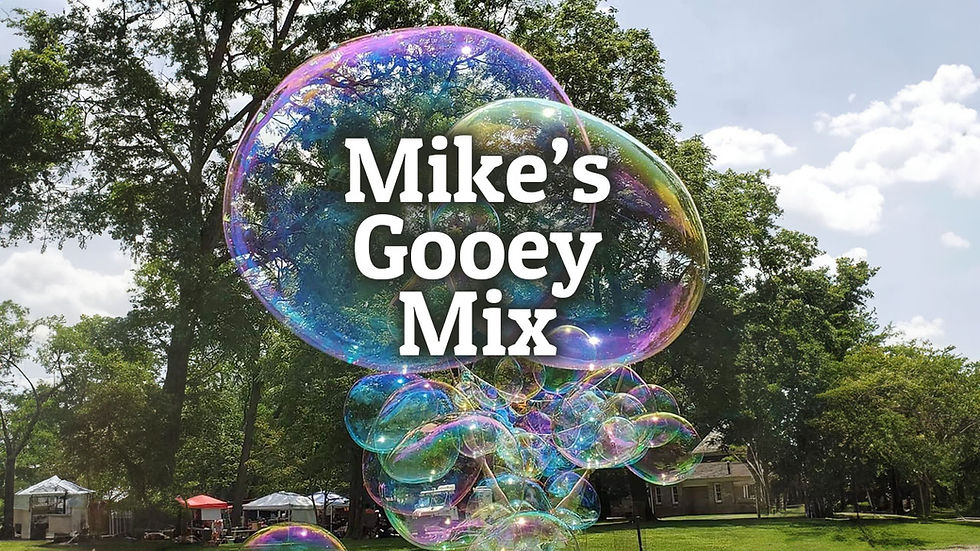
Alright Bubble U friends, let’s talk about one of the legendary bubble recipes floating around the community: Mike’s Gooey Mix.
This formula comes from Mike Miller, the founder of the Soap Bubble Fanciers Yahoo Group (SBF—RIP to one of the great early online bubble communities).
Mike’s bubble videos are absolutely beautiful and really speak for themselves.
This recipe has been shared through the Soap Bubble Wiki, which is an incredible resource for bubble science and formulas. I’m sharing it here so you can experiment with it yourself. It was my first bubble recipe, shared with me and I was sworn to secrecy - until I found the soap bubble wiki and discovered the real origin story!
One of the clever things about Mike’s approach is that he mixes a concentrate first, then dilutes it later with water when he’s ready to make bubbles. It’s a great method if you want to travel with your mix or prepare batches ahead of time. It also makes adapting your recipe on the fly really easy.
When diluted, the mix ends up with roughly a 17:1 water-to-detergent ratio.

Ingredients
Making the Concentrate
(This makes a concentrate that will later be diluted with water)
• 2 cups warm or hot tap water
• 2 cups Dawn Pro (Manual Pot & Pan)
• 7 grams baking powder (not baking soda!)
• 4 grams J-Lube powder
First, measure out your powders ahead of time.
Trust me—it makes things much easier once the mixing begins.
In a 4-cup measuring cup or larger container:
-
Pour in 2 cups warm or hot tap water.
-
Add 2 cups Dawn Pro.
-
Add 7 grams baking powder.
-
Now here’s the part where things move quickly.
Add 4 grams of J-Lube powder and immediately begin stirring briskly. Mike recommends using a large fork and creating a sort of circular, vortex-style motion through the mixture.
You want to mix it thoroughly without whipping up foam on the surface.
Keep stirring until most of the clumps disappear. Expect a minute or two of mixing—and maybe a little wrist workout.
Meadow's Alternative Mixing Method: I prefer to use jugs that I can close and shake, I've found that it mixes things more thouroughly but it means you have to do it a little differently.
1. Pour your 2 cups of hot water into a jug
2. Using a piece of paper that you used to hold your powders to weigh them on, carefully curl it to make a make shirt funnel and funnel them in, quickly closing the cap and shaking like your life depends on it. For about a minute. You can do each powder seperately or together - just know that you will need to "burp" it frequently but unscrewing the cap slightly to let some of the pressure out before screwing it back on and continuing to shake.
3. Add the Dawn pro - then "roll" the jug to mix. You don't want to shake because it will create foam.

Making a full Gallon of Concentrate
When Mike prepares a big batch, he pours the finished mixture into a gallon jug and repeats the process three more times until the jug is full.
That gives you one gallon of concentrate ready to go. I often just math up and double the recipe as I go - but I have found inconsistent results if you math up too much. It becomes more difficult to dissolve your powders at higher quantities. It's time consuming but better to do it in smaller batches and then combine them.
When I work a multi-day festival I factor in to go through 2 gallons of concentrate (16 gallons of bubbles, usually it's less. but I always factor in extra in case a zealous party-goer knocks over a whole batch!) I've found that the Dawn Pro jugs fit 4 to a milk crate and that makes for easy carrying (and less likely for an accidental spill to happen in your car -- don't ask me how I know.)
Diluting the Concentrate

When you’re ready to make bubble juice:
Add 2 cups of concentrate to 1 gallon of distilled water.
Some people find that tap water works fine unless their local water is very hard.
THIS IS IMPORTANT! The concentrate alone is way way way too thick to make bubbles.
It must be diluted!
You can add more concentrate or more water depending on the weather conditions. I've found adding more water in hot conditions helps and adding more concentrate in very humid or damp conditions creates really beauitful colors and long lasting bubbles (on a slightly damp and misty day near a body of water is ideal!)
When I first started performing with bubbles, I miscalculated the water ratio while diluting a big batch and ended up with extra amazing bubbles on a rainy day. A happy accident!
(see photo to the right)